I’m sending some comments a fellow
theater goer sent me after reading my review of The Piano Teacher production at KTC in early November. They are
spot-on and address some of my views poignantly and insightfully. I have the
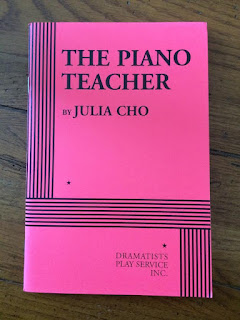
written text of the play (actor’s edition) and there is no direct mention of
WWII and the Holocaust in it, which does make the play’s theme of war’s effect
and influence on us, especially children, broader and more encompassing. I
think I saw the period reference because of the woman’s age who was telling the
story and the age of her husband when this happened to him, but, of course, it
could have been any number of conflicts in the world at that time or any other.
I agree that Mrs. K knew about her
husband’s past. She alludes to this as she talks to us, but the degree to which
she allows understanding to truly permeate her life is unclear. A thought comes
to mind now that perhaps she senses that if she allows full recognition of this
in her life, she will not be able to withstand the dark hold it could have on
her as it has had on her husband.
The comments about my review and
beyond:
…. about The Piano Teacher. I was wondering if the actual text of it, which
I think you said you'd read, explicitly says that the husband's experiences
were during WWII and the Holocaust. I can't recall when we were watching it
whether that was said explicitly. It seemed like it was vaguer, which of course
makes it even more relevant, as it could be referring to many places where
oppression and torture, etc. go on.
Just before you sent me the draft [of my review] I had started reading a little book called For Want of a Fir Tree, about the Ukraine and how relatively simple political protest escalated into war. It's written as if it's an explanatory letter or piece to a young child caught in the crossfire and killed, while he was sitting in his house. Very intense book which I didn't have time to finish, but will take out of the library again when I'm back home.
Anyway, it just reinforced the theme in the play about how young people can and are being affected by turmoil and war, and that it is often happening before they are the age to comprehend the political conflict underlying the action. And in those cases, does the lure of the violence, the dark side have a stronger power? Or, as this teen character in the play [Michael] seemed to say, he was drawn into it, and slowly realized it's attraction. It did make me wonder about young people in war zones, where all humanity seems to be under fire, and sometimes totally absent. How do they survive? I guess it's like the camps, and Victor Frankel's theories.
As to whether the wife "knew" what the husband was doing, I would have to say she knew about his past, and perhaps even knew he was still obsessed with it. I think that is why she was so intent on saying he was only reading the paper and doing crossword puzzles. She knew on some level that perhaps that wasn't all that was going on between him and her students. I'm not sure she could allow herself to see that he was sharing those stories with her students. And if he never shared them with her, she may not have imagined him doing it with others. But I'm going to say she saw things he drew-because didn't the teen make some mention of drawings? [He did and most emphatically.]
And how could she allow that knowledge into her life, especially once her husband was dead? It's that problem of evil people (abusers, psychopaths) sometimes seeming quite ordinary and nice. She knew him as her husband, and she seemed to be portrayed as the kind of woman who wanted a proper life, with a good, caring husband and so on.
But what do ordinary people do with this kind of knowledge of the dark side? Well, I guess we know, given recent political events. Some revel in it. And sometimes it just gets ignored. Or shoved under the carpet. But of course it doesn't go away. It's always there eating away at all that is positive, caring, loving.
I think of all the vets who are now struggling to live their lives after returning from war. We have created a huge population of people who have had to give part of themselves to the dark side as soldiers. And this is going on all over the world. Is it worse than it was in other centuries? I realize that cruelty and torture have always been a part of history and warfare.
Just before you sent me the draft [of my review] I had started reading a little book called For Want of a Fir Tree, about the Ukraine and how relatively simple political protest escalated into war. It's written as if it's an explanatory letter or piece to a young child caught in the crossfire and killed, while he was sitting in his house. Very intense book which I didn't have time to finish, but will take out of the library again when I'm back home.
Anyway, it just reinforced the theme in the play about how young people can and are being affected by turmoil and war, and that it is often happening before they are the age to comprehend the political conflict underlying the action. And in those cases, does the lure of the violence, the dark side have a stronger power? Or, as this teen character in the play [Michael] seemed to say, he was drawn into it, and slowly realized it's attraction. It did make me wonder about young people in war zones, where all humanity seems to be under fire, and sometimes totally absent. How do they survive? I guess it's like the camps, and Victor Frankel's theories.
As to whether the wife "knew" what the husband was doing, I would have to say she knew about his past, and perhaps even knew he was still obsessed with it. I think that is why she was so intent on saying he was only reading the paper and doing crossword puzzles. She knew on some level that perhaps that wasn't all that was going on between him and her students. I'm not sure she could allow herself to see that he was sharing those stories with her students. And if he never shared them with her, she may not have imagined him doing it with others. But I'm going to say she saw things he drew-because didn't the teen make some mention of drawings? [He did and most emphatically.]
And how could she allow that knowledge into her life, especially once her husband was dead? It's that problem of evil people (abusers, psychopaths) sometimes seeming quite ordinary and nice. She knew him as her husband, and she seemed to be portrayed as the kind of woman who wanted a proper life, with a good, caring husband and so on.
But what do ordinary people do with this kind of knowledge of the dark side? Well, I guess we know, given recent political events. Some revel in it. And sometimes it just gets ignored. Or shoved under the carpet. But of course it doesn't go away. It's always there eating away at all that is positive, caring, loving.
I think of all the vets who are now struggling to live their lives after returning from war. We have created a huge population of people who have had to give part of themselves to the dark side as soldiers. And this is going on all over the world. Is it worse than it was in other centuries? I realize that cruelty and torture have always been a part of history and warfare.